

A professional athlete, a working single mom, and a student with crippling anxiety enroll in the same school.
The principal looks at the school counselor and says, “Okay, now support them.”
Waiting for the punchline? There isn’t one. This wasn’t a joke — this was my real life as a school counselor in a statewide, virtual school. We served students with a huge range of needs, but they were all expected to fit within the same academic systems and expectations.
 After more than a decade in traditional public education, I thought I understood the diverse needs of students. But nothing prepared me for the range of students I served in a virtual setting. Virtual schools don’t serve one type of student — they serve everyone. Students from rural communities with limited access to services. Students in large cities struggling with social anxiety so intense they could not turn on their cameras. Students training at elite levels in sports or the arts. Students working full-time jobs. Students caring for siblings or their own children. Some logged in at 8:00 a.m. sharp. Others logged in at 7:00 p.m. after a full day of life responsibilities.
With a caseload of over 400 students, I quickly learned a hard truth: no matter how dedicated a counselor is, one person cannot meet the full emotional, social, and behavioral needs of such a complex population alone.
What made virtual schools especially challenging — and especially beautiful — was that need didn’t fit the boxes we expect. It wasn’t tied neatly to grades, geography, or income.
I had students who were doing well academically but were completely isolated socially. I worked with an elite gymnast whose perfectionism was so intense that they could not turn in assignments for fear of getting less than an A. These were not students who needed another meeting on their calendar or another adult telling them to “try harder.” They needed support that worked with the reality of their schedules and high demands — support that strengthened coping skills, emotional regulation, and mindset without adding to their mental load. They needed help that felt supportive, not punitive. Flexible, skill-based support that met them where they were, instead of becoming just one more thing they had to manage.
In a traditional school, Tier 2 support often happens naturally — small groups, hallway check-ins, lunch groups, quick pull-outs. In a virtual school, those moments don’t exist. Everything has to be intentional. Scheduled. Documented. Justified.
What I needed — and what virtual schools desperately need — is support that lives in the space between “you’re fine” and “you need therapy.”
More specifically, I needed systems that could provide:
- Flexible access for students who cannot meet during traditional school hours
- Support that acknowledges real life — work schedules, family responsibilities, emotional fatigue, and sometimes even time zones
- Structured, skills-based support for students who may not be failing, but are struggling with anxiety, motivation, perfectionism, isolation, and coping
- An option that reduces friction for students, rather than adding pressure, rigidity, or another obligation to manage
- Credit-bearing opportunities so students are not forced to choose between support and academic progress
- Clear tracking and data to show growth, engagement, and outcomes
- Documentation that makes the value of Tier 2 support visible and defensible to leadership and boards
It had to be more than just “extra time.” It had to be meaningful, skills-based, and measurable.
 One of the biggest misconceptions in education is this: if a student is passing, they’re okay. Virtual school taught me how false that is. Some of the students who worried me most were high-achieving. They could pass tests. They could turn in work — eventually. But they could not tolerate imperfection, manage stress, ask for help, or connect socially. These are the silent Tier 2 students — the ones who often slip through the cracks because they are not failing, but they are struggling. They were surviving, not thriving. Yes, they could graduate, but were they prepared for the pressures of college or career? And if we aren't intentionally building those skills before they leave us, are we really giving students all they truly need? For me, that meant support could not live on the margins — it had to count. When students could earn credit while building these skills, it sent a powerful message: this work matters just as much as academic content.
The greatest lesson I learned is not that counselors need to work harder — counselors already work incredibly hard. What virtual schools need are systems designed for the reality of virtual life. Systems that expand support beyond what one person can reasonably provide. Systems that make Tier 2 support flexible, structured, data driven and credit-bearing.
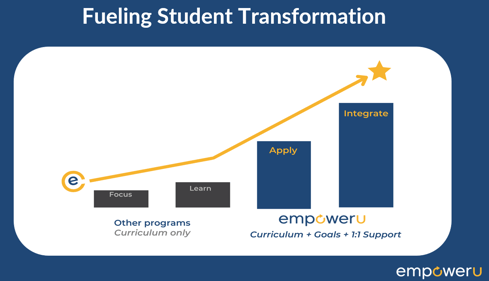 Today, as a Coach with EmpowerU, I often find myself thinking, "This is exactly what I needed back then." The work we do now reflects the gaps I felt every day as a school counselor — flexible support, skill-building for students who are not in crisis but are clearly struggling, and systems that make growth visible and meaningful.
Working in a virtual school was one of the most meaningful experiences of my career. I met students I never would have encountered in a traditional building. I witnessed resilience, creativity, and determination every day. That diversity of experiences is one of the greatest strengths of virtual schools — and also one of their greatest challenges.
Being part of EmpowerU now allows me to support schools and students in a way I always wished I could before — not by replacing counselors, but by expanding what is possible. Because at the end of the day, educators are not asking for easier jobs — we are asking for better tools. Tools that allow us to truly support the whole student. Tools that help students build the skills they need to manage stress, stay motivated, connect with others, and show up for their learning and their lives.
Virtual students deserve support that is as flexible and dynamic as the lives they are living. And through EmpowerU, I am grateful to now be part of work that helps make that level of support possible.
ABOUT EMPOWERU
EmpowerU’s highly personalized, data-driven Tier 1 and Tier 2 solutions equip students to be resilient, self-directed learners and reach their goals — without additional hires or a heavy lift from schools. The program provides each student with interactive lessons and personalized coaching, pairing technology with brain research in a unique way that supports students, empowers their growth and reduces feelings of anxiety and depression. Multi-year data makes it clear: nobody understands Multi-Tiered System of Supports (MTSS) and approaches student supports the way EmpowerU does.
Ready to get started? Schedule a consultation with your EmpowerU school partnership director to learn how you can bring these results to your districts.